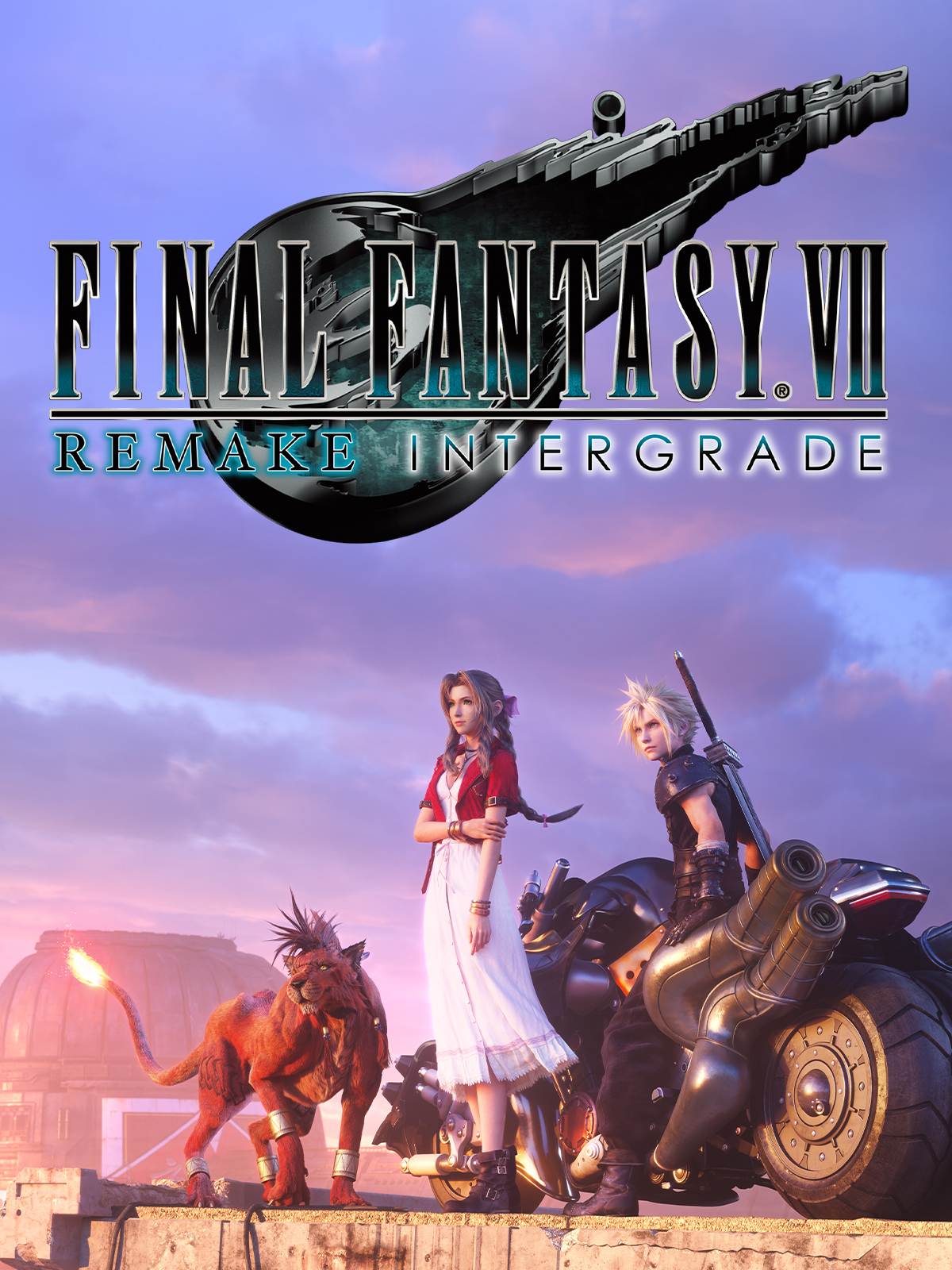
Final Fantasy VII Remake
Overview
I never played the original Final Fantasy VII. In fact, I went into the game almost completely blind, knowing only the things that I learned from Internet pop culture. I don't think I could have made a better choice. While the game most definitely had a few struggles, it is easily one of the greatest I've ever played, and I'm excited to start Rebirth once it releases on PC. For now though, let's get to the actual review.
A First Look at Midgar
The game starts in medias res. We play as Cloud, a mercenary working for a terrorist organization called Avalanche in the city of Midgar, which is divided into an upper section suspended thousands of feet above the ground and a lower section underneath it. Also in our group is Barrett, the leader of the group, Jessie, the demolition expert, Biggs, the technician, and Wedge, whose role is really quite unclear to be honest. The group is attacking a Mako reactor with the intention of destroying it, and Cloud was hired as a bodyguard.
The tutorial is brief, yet effective. Players are quickly taught how combat and traversal works, and the former is one of the highlights of the game. Even just from the first few moments, every encounter feels fluid and intense. Enemies have enough health to warrant using more powerful attacks on them, but not so much that they become damage sponges, and the ability to shift between the Operator and Punisher stances as Cloud greatly enhances both his moveset and the strategic possibilities in combat.
By far the most standout feature, though, is the ATB system. Calling back to the series' roots as a turn-based RPG, ATB is charged up over time and by attacking enemies. When charged, players can consume ATB to use more powerful attacks, as well as spells and items. This heavily incentivizes active and aggressive gameplay, as sitting back and waiting for ATB to charge takes longer than it is worth. The system also encourages players to switch characters regularly, as the bonus ATB from attacking only applies to the character who is currently being controlled by the player. The entire system greatly compliments the aggressive combat and intense gameplay provided by the normal ARPG combat.
Continuing on in the story, Cloud and Barrett make their way down into the deepest recesses of the reactor and plant the time bomb they plan to use to blow it up. Shinra (the company who owns the reactors), however, has other plans, and a large, scorpion-like robot is sent to attack the two. This marks the first major boss fight in the game. Boss fights in Final Fantasy are nothing new. In fact, they’re quite common, with many chapters featuring three or more major fights. While this does lead to a greatly increased variety of gameplay, not every idea is a winner, and many of the bosses in the game end up falling flat, a topic that will be touched on later.
The story takes an interesting deviation from the original at this point. In the original Final Fantasy VII, the bomb Avalanche plants is too powerful and causes the reactor to explode much more violently than anticipated, causing numerous civilian deaths. In Remake, though, it is instead Shinra who adds to the explosives, hoping to cause more damage and turn the people against Avalanche. While this change seems odd at first, it makes much more sense when looking at the length of both games. The content covered in the roughly thirty hours of gameplay covered by Remake happens in about five hours in the original. This change is invaluable because, while the original got to the really evil parts of Shinra extremely fast, Remake takes many hours to get there. The Mako reactor, in turn, helps to make sure that Shinra is still obviously evil. With the reactor gone, the introduction is over, and the main story truly begins.
Examining the Story
The introduction is, in my opinion, the most interesting section storywise of Final Fantasy VII Remake besides the finale. For most of game, the plot is standard and straightforward. Shinra is evil, and the player's job is to play the hero and destroy it. As the game progresses, Shinra continues to be evil and do evil things, like evil companies filled with evil people tend to do. They kidnap citizens and use them in human experiments, pay off news outlets to spread misinformation and propaganda, and, in an attempt to flush out Avalanche, drop the upper section of Midgar onto the slums below, killing thousands. Shinra is inexcusably evil, and it creates a refreshingly simple conflict which allows the story to instead focus on the characters.
On the topic of characters, this is one section where the game excels. Every character has their own motivations, goals, and people important to them. While Barrett is hostile on the surface and intially rather aggressive towards Cloud, the two quickly bond and become good friends. Barrett is also the single father of a young daughter, Marlene, who acts as much of his motivation to keep himself alive rather than running off and getting himself killed. Cloud is also interesting. While he initially treats his interactions with Avalanche as a simple business deal and nothing more, he very quickly becomes close to the main cast, and keeping the people he cares about safe becomes one of his main driving goals.
Unfortunately, not every character can be a winner. Tifa especially falls flat in my opinion. Her design, fighting style, and role in the story all set her up to be the "cool" character. She's a quick, strong, and athletic fighter, beating sewer rats, trained soldiers, and government superweapons to death with only her bare hands. Unfortunately, much of her characterization is quite dated. Despite being clearly designed to be a serious and cool character, she regularly loses all of that characterization in favor of emphasizing her femininity. As a result, her character feels conflicted. On one side, her gameplay frames her as a strong, serious fighter who punches first and asks questions later. On the other, she spends half of her screentime in cutscenes yelling "Cloud!" and never gets a chance to shine herself. Instead, she is relegated to the role of a damsel in distress, and the conflict between the two sides of her character makes her unbearable to watch.
The other place where the writing really struggles in this game is the ending. Obviously the ending was quite open, as there's still two more sequels yet to be released. The finale, though, was rather confusing. An important group of entites throughout the game were "Whispers" ghost-like figures who regularly interfere with the events of the story. They return in the finale, and their true nature is finally revealed. They are "arbiters of fate" whose job is to ensure that the events of Remake follow the story of the original game perfectly. In the finale, Cloud and the group fights against these Whispers, and eventually destiny itself. By winning this battle, they are freed from the influence of the Whispers, implying that the story in Rebirth will be different. The meta-narrative here is somewhat genius, but it's also heavily limited by the poor execution. As someone who never played the original, I had no context for the fact that the Whispers were changing things to fit the original games, and I didn't learn about this until I looked it up after beating the game because it was so poorly explained. This led me to feel confused for the majority of the finale, as the stakes and scenario were incredibly unclear.
The finale does redeem itself somewhat with the fight against Sephiroth. Sephiroth spends the entire story in the background, an ominous threat that we as players never quite understand the nature of. The ending fight against him makes good use of this buildup, yet still manages to maintain much of the mystery surrounding him. The fight against Sephiroth is long and difficult, and he casually brushes off most attacks while simultaneously dishing out massive amounts of damage. He uses abilities similar to those already available to players - most of his attacks are either directly taken from materia available to the player or, as with Telluric Fury and Aeolian Onslaught, visually resemble attacks that Cloud uses, albeit more powerful. The buildup is slow and mysterious, but the payoff is entirely worth it, and the fight is one of the most memorable in the game.
Let The Battles Begin!
The combat in Final Fantasy VII Remake is unsurprisingly one of its strong suits. Battles feel fluid and intense, and there is enough variety of enemies to ensure that new challenges are constantly presented. Each character has a unique moveset that sets them apart from the others, and the wide variety of weapon skills and materia further enhance the strategic side of battes. Even the music is impeccable, with the transitions from overworld themes to battle music instantly alerting players to new threats.
Perhaps the most important part of combat is the ability to switch characters at any time. This mechanic is wonderfully fleshed out, and perfectly suits the ATB mechanics of the game, which encourage players to switch characters after using a special move since characters using an ability cannot be controlled for a short time. Even better, three of the characters have genuinely engaging and interesting movesets that are all drastically different from one another. You may have noticed, though, that I said three. This is because of Aerith. Aerith is the mage of the party, but unfortunately struggles quite a bit in terms of gameplay because she lacks one important thing: impact. Cloud and Tifa are both melee characters, and the audio and physical reactions of enemies make it clear to the player that the attacks are powerful. Barrett, meanwhile, has a bullet at the end of each magazine that does extra damage and causes most enemies to stumble a bit backwards. Again, this attack has impact. Aerith, however, gets none of this. When built for damage, she is extremely powerful, but she never recovers from the fact that her attacks always feel weak. Additionally, she attacks rather slowly, and cannot move while doing so, taking away the two things that could have made playing as her engaging. Her only saving grace is that her attacks pack a punch when they do hit. Unfortunately, this is still not enough to save her. As a result, Aerith is significantly less enjoyable to play as, and I found myself avoiding her whenever possible.
Despite Aerith's shortcomings, though, the rest of the cast is extremely enjoyable to play as. While I mostly made use of Cloud and Barrett when given larger parties, I found myself drawn to Tifa as I neared the end of the game. Her fighting style was the most hands-on, largely due to her abilites Unbridled Strength and Focused Strike. Unbridled Strength increases her damage for a time and allows her to access new combat abilities. Focused Strike, meanwhile, inflicts a small amount of damage and high stagger. It also restores most of the ATB spent on it upon landing a successful hit. Between these two abilities, her fighting style is by far the most active in the game.
Cloud was another character that I found to be quite enjoyable to play as. Since he's in the party for nearly all of the game, he is built as a sort of jack-of-all-trades. He has high health, strong damage output, and an MP supply surpassed only by Aerith. He also has the ability to enter Punisher Mode at any time, raising his damage output at the cost of losing his ability to block. Cloud's special abilities were also fun to bplay with, with iconic abilities like Braver and Blade Burst being some of his most powerful. This, combined with the fact that he can be built for any purpose, made Cloud feel like the most varied character in the main cast.
Barrett is, in my opinion, an amazing example for how to make a standout character in an ARPG. He is designed to be used in one of two roles: a tank or a DPS. Barrett's abilities as a tank are obvious. With abilities like Steelskin to increase his defenses and Lifesaver to take damage for the party, he is incredibly good at keeping his fellow Avalanche members alive. This, however, is not his only use. Barrett also has access to the abilities Focused Shot and Maximum Fury. Both of these abilities have high damage output, and that damage is raised if Barrett is at max ATB when using them. Combined with his ability to quickly farm ATB from a distance with his gun arm, Barrett can instead be built to be the primary DPS for the team. This approach to character design is perfect. Since he has two different ways to build him, players have a significant amount of agency in how they use him in battle. Since the number of uses for him is still quite low, though, he has multiple abilities that are of high usefulness, no matter how the player builds him.
Bosses - The Good, The Bad, and the Eligor
There are numerous bosses throughout Final Fantasy VII Remake. Some of them are peak design, while others are absolutely miserable. This is, unfortuantely, a consequence of having so many bosses. While each one likely got plenty of attention, as evidenced by the credits mentioning an entire team of people dedicated to designing the boss fights, some of them are simply better.
A great example of a well-designed boss is Reno's fight in the church. The fight takes place immediately after Cloud is separated from the rest of Avalanche, and it puts a real test on players' mechanical skill, observational abilities, and understanding of battle systems. Reno himself is relatively simple. He has a few melee attacks and in general just tries to beat Cloud to death with a metal stick. The interesting part of his fight, though, is his counter ability. If Cloud attacks him, Reno will dodge, landing a powerful blow and stunning Cloud for a few seconds. This ability can be particularly devastating if he chains it into another attack, and actually ended my first attempt against him. Faced with this ability, my first instinct was to block and hope I could at least stall for time. Upon doing so, though, I noticed something interesting. Because Reno attacked so quickly and aggressively, he was knocked off balance when hitting Cloud's impeccable defense. This allowed me to land hits without being countered, and I very quickly won the fight after realizing this. Reno's fight is an example of peak boss design - introduce a problem that players have to work around, and reward them for figuring out a solution - and luckily, most bosses in the game are like this.
Not all the bosses in the game are as good as Reno, though, as evidenced by the existence of the Hell House. The Hell House isn't a poorly designed boss in terms of mechanics, visuals, or music. Instead, it struggles because of poor balancing. The Hell House, like an actualy house, can take dozens of hits before being damaged. The Hell House, however, isn't supposed to be a house. It's supposed to be a boss. The sheer tankiness of the Hell House makes the boss fight a drag. It does everything right in every other manner as well, but that only serves to further accent the balancing issues. The Hell House has a clear and exploitable weakness, but successfully taking advantage of it never feels impactful because of how little damage is done anyways. Additionally, the house is largely resistant to physical damage, like that from Cloud's sword. This normally wouldn't be a problem, as players can just switch to another character who doesn't deal physical damage. Unfortunately for Hell House, though, the only other available character is Aerith, who, as mentioned above, doesn't feel particularly good to play as. This leads to even less engagement as players sit there holding the attack button and occasionally casting a spell to bring down the Hell House's defenses. Additionally, as I said earlier, Aerith's only saving grace in gameplay is her high attack damage. Because of how tanky the Hell House is, though, her high damage starts to feel low as well. Had the Hell House had better balancing, it would have been one of the most memorable moments of the game. Due to a single mistake, though, it is instead one that most players just want to forget.
Despite its problems, the Hell House is not the worst boss in the game. That title instead goes to Eligor. Eligor is already placed in one of the worst parts of the game - Chapter 11. The chapter is wedged between the escape from the sewers and the attack on the Sector 7 pillar, both among the most tense sections of the game. Additionally, the entire chapter is filler, with no character development and no later plot significance. This already sets Eligor up for failure. What's worse, though, is the actual design of the boss. Like the Hell House, Eligor is resistant to physical damage, again forcing players to use Aerith, and essentially making both Cloud and Tifa useless for much of the fight. Even worse, he lacks a well-designed weakness. Both Reno and the Hell House have interesting weaknesses, with Reno being stunned after hitting a blocking Cloud and the Hell House having its defenses reduced when hit with a materia of the opposite type of its current shield. Eligor has none of this. Instead, he just has an elemental weakness to ice materia. This doesn't sound terrible until you realize how ice materia works. Every spell in the set hits an enemy and then sits there for around a second before exploding and dealing damage. While this is fine with slower enemies, Eligor is a highly mobile boss. As a result, he almost always avoids the damage. The issues don't stop there. During his second phase, Eligor ascends into the sky. While in the air, he is also weak to wind attacks, which, while still not a particularly inspired weakness, is still better than one that can't be used. Altogether, Eligor feels bad to fight, and doesn't feel any better to beat.